HSC · 2017 syllabus · 2019–2026 papers
Investigating Science What eight HSC papers tell us about 2027
Every question from 2019–2026, analysed by syllabus dot point, outcome, command verb and stimulus · Prepared November 2026 for Investigating Science teachers
Headline numbers from the teacher brief
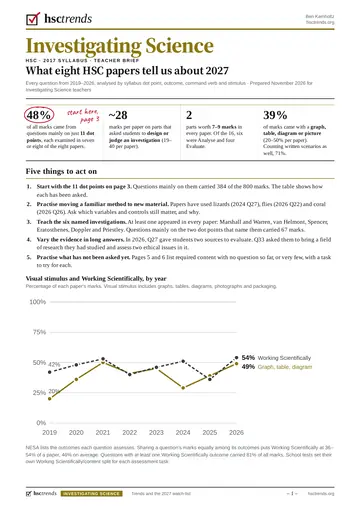
- 48% of all marks came from questions mainly on just 11 dot points, each examined in seven or eight of the eight papers.
- ~28 marks per paper on parts that asked students to design or judge an investigation (19–40 per paper).
- 2 parts worth 7–9 marks in every paper. Of the 16, six were Analyse and four Evaluate.
- 39% of marks came with a graph, table, diagram or picture (20–50% per paper). Counting written scenarios as well, 71%.
Downloads free to print and share
Teacher brief
Trends and the 2027 watch-list
For teachers and heads of department planning the 2027 course. Its five things to act on:
- Start with the 11 dot points on page 3
- Practise moving a familiar method to new material
- Teach the six named investigations
- Vary the evidence in long answers
- Practise what has not been asked yet
Then how the paper is built, the 2027 watch-list year by year, required content not yet examined, what markers reward, and the method.
Download the teacher briefPDF · 6 pages · 136 kB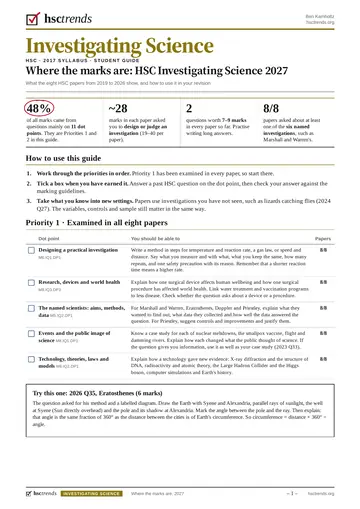
Student guide
Where the marks are, 2027
What the eight HSC papers from 2019 to 2026 show, and how to use it in your revision. For Year 12 students to print and tick off. Its headline numbers:
- 48% of all marks came from questions mainly on 11 dot points. They are Priorities 1 and 2 in this guide.
- ~28 marks in each paper asked you to design or judge an investigation (19–40 per paper).
- 2 questions worth 7–9 marks in every paper so far. Practise writing long answers.
- 8/8 papers asked about at least one of the six named investigations, such as Marshall and Warren’s.
Sections:
- How to use this guide
- Priority 1 · Examined in all eight papers
- Priority 2 · Examined in seven of the eight papers
- Priority 3 · The rest of the top 20
- Don’t get caught out
- What markers reward
The papers themselves
The reports refer to questions by year and number. The papers, marking guidelines and marker feedback are published by NESA: NESA’s HSC exam papers: Investigating Science. How it works explains how the marks were counted.